


- 09 October, 2026
Reinforcing steel plays an important role in reinforced concrete construction. However, the durability of steel reinforcement can be affected by environmental exposure. Moisture, chloride ions, and certain chemicals can contribute to corrosion over time. Epoxy-coated reinforcement bars are designed to provide an additional protective barrier around the steel surface, helping reduce corrosion-related deterioration.
Nagarjuna Ultra Epoxy offers fusion-bonded epoxy-coated (FBEC) TMT reinforcement for construction environments requiring additional corrosion resistance. The company's published product information describes an epoxy coating of approximately 200 GSM, designed to reduce direct exposure of the steel surface to moisture and chlorides.
What Are Epoxy-Coated Reinforcement Bars?
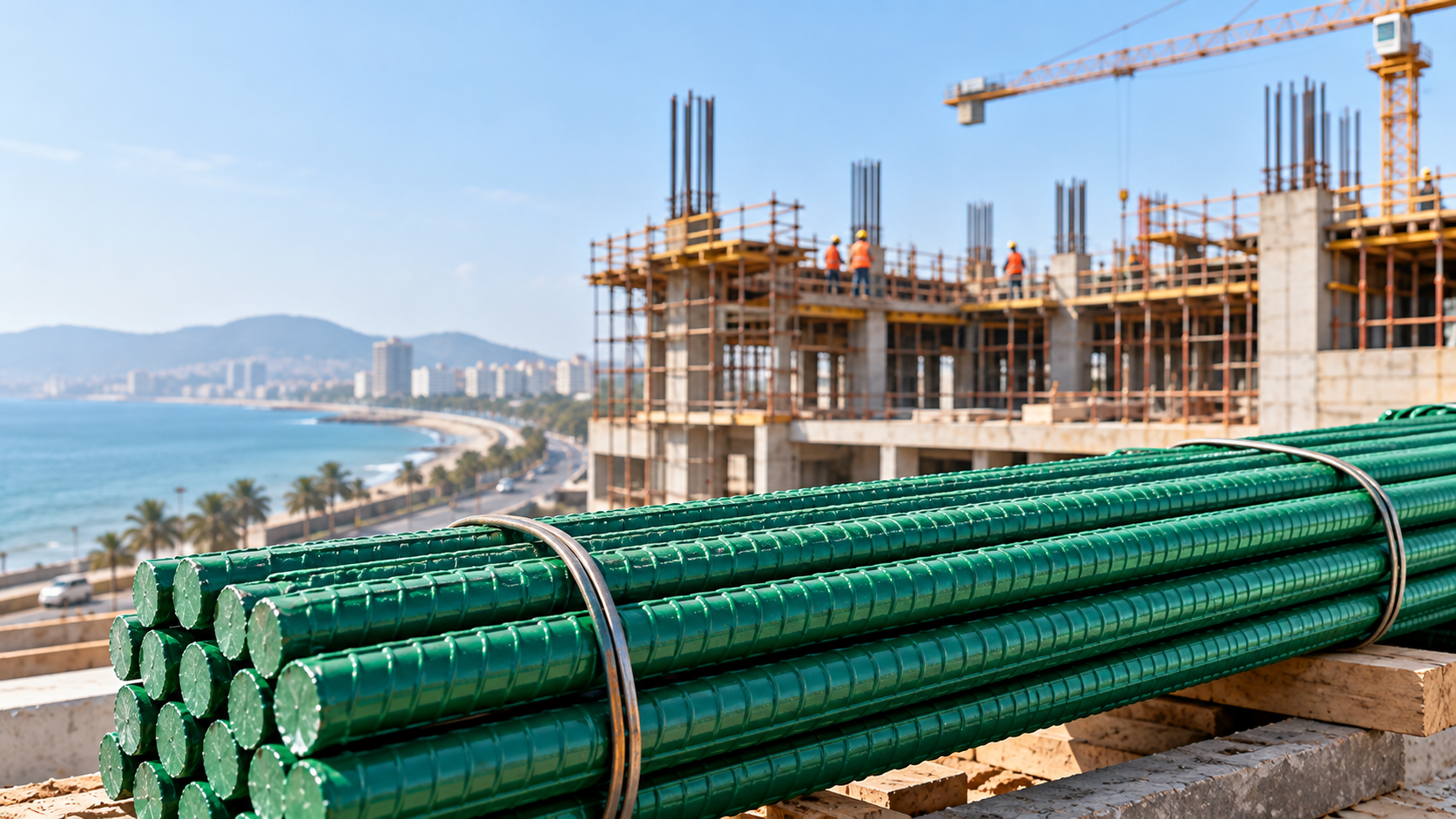
Epoxy-coated reinforcement bars are steel reinforcement bars covered with a protective fusion-bonded epoxy coating.
The coating is designed to reduce contact between the steel surface and external corrosive substances. The underlying reinforcement provides the required mechanical strength, while the epoxy layer offers additional corrosion protection.
The Bureau of Indian Standards (BIS) specifies requirements for fusion-bonded epoxy-coated reinforcing bars under IS 13620.
The standard covers coating characteristics and performance requirements, including coating thickness, continuity, adhesion, chemical resistance, abrasion resistance, impact resistance, and other relevant properties.
What Is the Role of Epoxy Coating in Reinforcement?
The surface of uncoated steel can be affected by corrosive substances when exposed to moisture, chlorides, and other aggressive environmental conditions.
Concrete normally provides protection to embedded reinforcement. However, moisture and chlorides may penetrate through cracks, pores, or other pathways over time.
Epoxy coating provides an additional protective barrier that helps reduce direct contact between the steel surface and corrosive substances. This can contribute to the long-term durability of reinforced concrete structures.
However, the effectiveness of epoxy-coated reinforcement depends on proper manufacturing, handling, installation, and structural design. Damage to the coating can reduce its protective performance.
Fusion-bonded epoxy coating involves applying epoxy powder to a properly prepared and heated steel surface, where it bonds to form a protective layer.
Surface preparation and controlled application are important for achieving suitable coating adhesion and uniformity.
IS 13620 provides requirements for fusion-bonded epoxy-coated reinforcing bars. Coating application and inspection should follow the applicable standard and manufacturer specifications.
Why Use Epoxy-Coated Reinforcement Bars?
Epoxy-coated reinforcement bars offer additional corrosion protection for construction projects exposed to challenging environmental conditions.
In environments with moisture, chlorides, or other corrosive substances, the protective coating helps reduce direct exposure of the steel surface.
These corrosion-resistant reinforcement bars can contribute to improved structural durability when used with suitable concrete quality, adequate concrete cover, and proper construction practices.
By reducing the risk of corrosion-related deterioration, epoxy-coated reinforcement may also help lower maintenance and repair requirements over the structure's service life.
Applications of Epoxy-Coated TMT Bars
Coastal Construction
Structures near coastal environments may experience increased chloride exposure from seawater and salt-containing air.
Epoxy-coated reinforcement can provide additional corrosion protection for reinforced concrete structures exposed to these conditions.
Industrial Structures
Industrial facilities may be exposed to moisture, chemicals, and pollutants that contribute to reinforcement corrosion.
Where environmental exposure creates a significant corrosion risk, epoxy-coated TMT bars can be considered as part of the structural durability strategy.
Parking Structures
Parking structures may be exposed to moisture, contaminants, and repeated wetting and drying.
Using corrosion-resistant reinforcement can help reduce corrosion-related deterioration where the exposure conditions justify additional protection.
Nagarjuna Ultra Epoxy TMT Bars
Nagarjuna Ultra offers fusion-bonded epoxy-coated TMT bars as reinforcement solutions for construction projects requiring enhanced corrosion protection.
The company'sepoxy-coated TMT bars feature a protective coating designed to reduce direct exposure of the steel surface to moisture and chlorides.
Nagarjuna Ultra's published product information describes an epoxy coating thickness of approximately 200–300 microns. The final coating specifications should be verified against the latest manufacturer documentation and applicable project requirements.
Coating Quality
Important coating characteristics include thickness, continuity, adhesion, and resistance to damage during handling and installation.
These factors influence the effectiveness of the protective layer.
Steel Grade
The underlying reinforcement must meet the required mechanical and material specifications.
IS 1786 specifies requirements for high-strength deformed steel bars and wires used for concrete reinforcement.
The steel grade should be selected according to structural design requirements, while the epoxy coating provides additional corrosion protection.
Handling the Coating
Epoxy-coated reinforcement should be handled carefully during transportation, storage, fabrication, and installation to avoid damaging the protective layer.
Any damaged coating areas should be inspected and repaired, where permitted, according to the manufacturer's recommendations and applicable project specifications.
Structural Design
Epoxy-coated reinforcement should be incorporated into structural design according to applicable engineering standards and project requirements.
Because coating characteristics may influence the bond between reinforcement and concrete, the structural engineer should consider relevant design provisions.
The primary difference between conventional and epoxy-coated reinforcement is the additional protective layer.
The selection of suitable reinforcement depends on:
- Environmental exposure
- Intended design life
- Project specifications
- Maintenance requirements
- Construction conditions
- Overall project costs
Why Choose Nagarjuna Ultra Epoxy?
Nagarjuna Ultra has more than thirty years of experience in the steel industry and offers reinforcement products for residential, commercial, industrial, and infrastructure applications.
Its fusion-bonded epoxy-coated TMT bars are designed to provide additional corrosion protection in environments where moisture, chlorides, and other corrosive substances may affect reinforcement durability.
For projects requiring corrosion-resistant reinforcement, Nagarjuna Ultra provides epoxy-coated TMT bar options that can be evaluated according to structural specifications and environmental exposure conditions.
Builders and engineers can also explore Nagarjuna Ultra'sTMT manufacturing process to understand the production stages involved in manufacturing reinforcement steel.
Conclusion
Epoxy-coated reinforcement bars provide an additional protective barrier that helps reduce corrosion risks in reinforced concrete structures exposed to challenging environmental conditions.
They are particularly useful for projects where moisture, chlorides, or other corrosive substances may affect the long-term durability of reinforcement.
Nagarjuna Ultra's fusion-bonded epoxy-coated TMT bars are designed for construction applications requiring enhanced corrosion protection. When combined with proper structural design, concrete quality, and installation practices, epoxy-coated reinforcement can contribute to durable reinforced concrete structures.