


- 15 April, 2026
The Part of Construction Nobody Sees
When people build a house, they usually talk about design first.
Front elevation. Tiles. Paint. Maybe even lighting.
Steel? That comes much later in the conversation. Often, the decision is made quickly: “Which brand?” and then it’s done.
But if you pause for a second, the entire structure depends on something that will never be visible again once the concrete is poured.
That’s where the TMT bar manufacturing process quietly becomes important.
Not in a dramatic way. More like something that works in the background, deciding how your building behaves years later.
It Doesn’t Start in a Factory. It Starts Much Earlier
Before machines, before heat, before shape, it’s just material.
Iron ore, scrap pieces, and sometimes recycled steel. All of it was collected, sorted, and selected. You wouldn’t notice anything special if you saw it lying around.
But this is where things begin to go right or wrong.
Cleaner input means fewer corrections later. Poor selection, on the other hand, carries forward. It doesn’t disappear magically in later stages.
People often skip this part when thinking about how TMT bars are made, but this is where the tone is set.
The Furnace Doesn’t Just Melt, It Resets
Once the material goes into the furnace, everything changes form.
Solid becomes liquid. Structure disappears. You’re left with molten steel that can now be controlled.
There’s a bit of judgement involved here. Not everything is automated thinking. Temperature, timing, and composition all need attention.
Too much of one element causes the steel to react differently later. Too little, and it won’t perform under stress.
This stage is less about force and more about balance, even though it’s happening at extreme heat. It’s one of those moments in the TMT bar manufacturing process where small decisions have long consequences.
A Shape Appears, But It’s Still Not a Bar
The liquid steel is poured into moulds and allowed to solidify.
What comes out are billets. Thick, long blocks that don’t look like finished products yet. If anything, they look incomplete.
But billets are like a base version of what’s coming next. They carry the internal structure forward.
If something goes wrong here, such as a minor inconsistency or a hidden defect, it will not remain here. It travels ahead to the next stages of TMT bar manufacturing.
Stretching Steel into Form
The billets are heated again. Not melted this time, just softened.
Then they go through rolling mills.
You can imagine it like this. Each set of rollers presses and stretches the metal a little more. With every pass, the shape changes. Thinner. Longer. It's close to what we recognise.
There’s a rhythm to it. It has a comfortable pace.
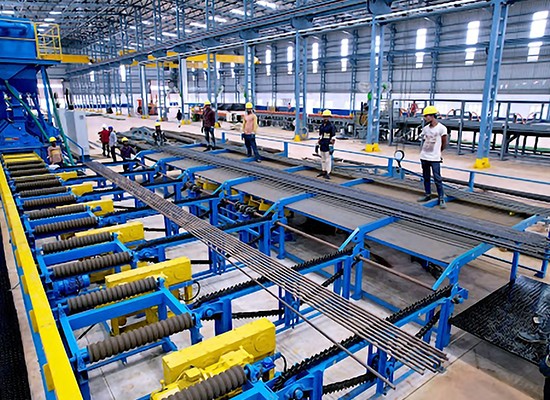
This phase is probably the most visible part of the TMT bar production process, where steel starts to look like something usable on-site.
Then Comes the Part That Actually Makes It “TMT”
Up until now, it’s just shaped steel.
What happens next provides it with character.
The bars, still hot from rolling, are exposed to sudden water cooling. Not gradual, immediate.
The outer layer reacts instantly and hardens. The inside doesn’t receive the same shock, so it stays softer.
That difference is what makes it harder outside and softer at the core. TMT bars behave the way they do.
They don’t snap easily. They bend and adjust under stress.
Without this stage, the TMT bar manufacturing process would produce something far less dependable in real construction.
There’s No Machine for What Happens Next
After quenching, the bars are left as they are for a moment.
And then, something subtle happens.
The heat from the inner core moves outward. It tempers the hardened surface without the need for external intervention.
It’s not something you can see happening, but it matters.
Many simplified explanations of how TMT bars are made skip this step, but the quenching phase naturally improves strength.
Cooling: But This Time, Slowly
Once that internal adjustment settles, the bars are allowed to cool in open air.
No water, no force. Just time.
If everything is rushed, the material can develop internal stress. This stage gives it room to stabilise.
It’s one of those steps in the TMT bar production process that doesn’t look impressive, but skipping it would cause problems later.
Those Patterns Aren’t Random
Pick up a TMT bar, and you’ll notice ridges along its surface.
They’re not decorative.
Concrete needs something to grip onto. A smooth surface wouldn’t hold as well, especially under load.
So, these ribs are designed to improve bonding.
It’s a small detail, but it plays a role that becomes clear only after construction begins. Another quiet yet important step in TMT bar manufacturing.
Getting Everything into Standard Form
At this stage, the bars are cut.
Measured. Checked. Aligned.
Construction doesn’t work well with variation. If one bar is slightly off, it affects placement, spacing, and sometimes even load distribution.
So, uniformity becomes important here.
Testing Isn’t Just a Formality
Before anything leaves the plant, it goes through testing.
Not the kind done just for records, but actual checks that reflect real usage.
Can it bend without cracking?
Does it return after stress?
Is the strength consistent across batches?
These questions matter more on-site than in a lab, but this is where they’re answered.
This final step completes the TMT bar production process, transforming shaped steel into a reliable component inside a structure.
Where Are Things Changing Today?
Earlier, making strong steel was enough.
Now, people have started thinking about what happens after years of exposure.
Moisture, air, and chemicals don’t attack immediately. But over time, they do their work.
Rust is slow, but once it begins, it doesn’t stop easily.
This is why some manufacturers have moved towards coated variants. Epoxy coating, for example, acts like a barrier.
It doesn’t replace the TMT bar manufacturing process, but it adds a layer that helps the steel to live longer.
What Should You Really Take from All This?
Not every buyer needs to understand every stage in detail.
However, having a basic understanding of how TMT bars are made can change your perspective.
It stops being just another item on the construction list.
You start seeing it as something that has already gone through multiple stages before reaching you, each one shaping how it will perform later.
Conclusion
A TMT bar looks simple.
Straight. Ribbed. Standard.
But behind that simplicity is a long chain of steps: heating, shaping, cooling, adjusting, and testing.
The steps in TMT bar manufacturing don’t shout for attention. They don’t show up in brochures the way design does.
But they decide how a structure stands, ages, and survives.
And that’s not something you want to leave to chance.
Related Article: Is Epoxy-Coated Rebar Better? CRS Rebar vs Epoxy-Coated TMT?